
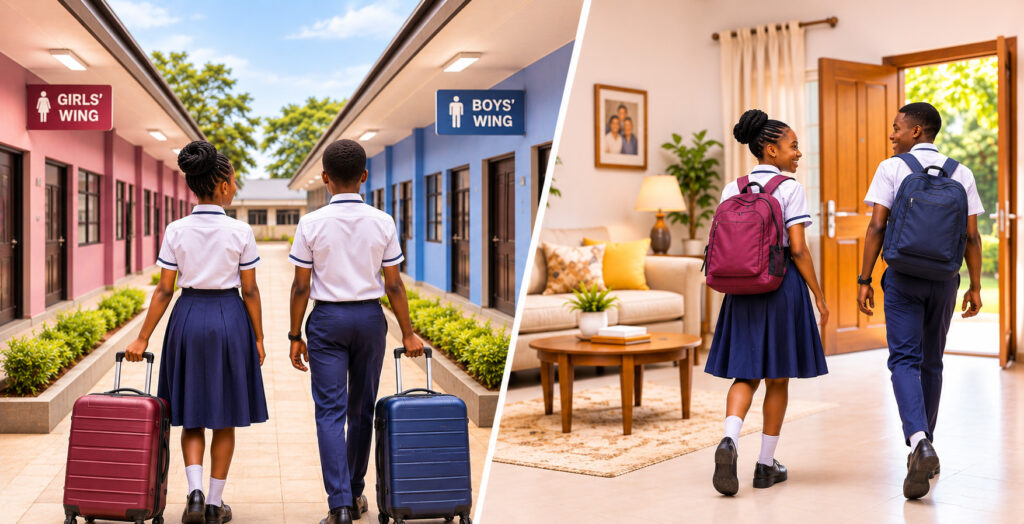
Independence, discipline, academic excellence, exposure, parental convenience or a gamble with childhood? As parents and former students revisit their boarding-school experiences, one question remains: Is boarding school really the best environment for every child?
For parents, deciding between day school and boarding school is rarely just about academics – it is a question of timing, values, safety, and knowing your child.
In our November session in LRM, we opened a figurative “teenager’s diary” to look honestly at what happens inside the boarding house versus at home. Drawing on the experiences of former boarders, proud day students, educators, and parents, our conversation quickly moved past a simple “yes or no” to uncover what truly makes or breaks the boarding experience today.
What emerged was not a straightforward argument for or against boarding school. Rather, it was a reminder that children are different, parenting circumstances vary, and the decision deserves considerably more thought than simply choosing a school.
- Boarding vs. Day School: Would you do it all over again?
We began with a simple but revealing question. When asked whether they would repeat their secondary school setup, participants stood firmly by their own paths—proving that neither system holds a monopoly on raising well-adjusted teens.
- The case for boarding: Former boarders credited hostel life with building early self-reliance, adaptability, and exposure to peers from diverse background. Living on a strict timetable of morning duties and prep time taught them structure that later made university life effortless. One particularly mentioned that her boarding school gave her an early strong faith foundation, something she probably might not have had at home at that time. For another participant, the experience of being a boarder and subsequently a day student offered a balanced perspective. Both environments had their advantages, and neither could be dismissed outright.
- The case for day student: Proud day students pointed to home-cooked meals, family warmth, and real-world independence. One participant used his afternoons after school to learn a trade earning his own income before he even reached senior secondary school. A craft he maintained he found beneficial till date.
- Why one size never fits all: Several participants shared starkly contrasting experiences even within the same family. While one speaker loved the freedom and thrived on the structure of morning duties and prep time of boarding school, another felt trapped in a system that stifled his happiness and grades, only flourishing academically after returning home. As participants noted, even identical twins mature differently; boarding school is never a “one-cap-fits-all” decision.
- The “Rush” Problem: Age and Gender Readiness
A major consensus point centred on rushing children into secondary school too early. With double promotions and accelerated primary schooling, many nine- and ten-year-olds are entering JSS 1, years before they are emotionally ready.
- Don’t rush the calendar: One participant with a background in developmental psychology shared that she entered JSS 1 at age nine and finished secondary school before 15, yet didn’t gain university admission until 19. Speeding through primary school often leads to waiting later in some cases, anyway. Her rule as a parent is firm: no child under 10 should be sent to boarding school. When asked what to do if a child finishes early, she shared how a friend’s father had made her wait at home for a full year before allowing her to transition into secondary school. Sometimes, allowing an additional year for maturity and development may be more beneficial than rushing the process.
Others agreed that there was little justification for hurrying children into the next stage simply because they were academically capable. An important distinction emerged here: Academic readiness is not necessarily the same as emotional, social or physical readiness.
A child may be intelligent enough to handle secondary-school subjects but may not yet possess the emotional maturity to cope with prolonged separation from family, peer pressures, unfamiliar environments and the responsibilities of communal living.
There is also no universal age that automatically makes every child ready. Maturity develops differently, and parents must look beyond chronological age when making this decision.
- The gender factor: Another compelling layer was introduced into the conversation, does gender change the equation? A father of all boys noticed that while he had no hesitation sending his son to secondary school after Primary 5, yet across his wider circle, parents of equally brilliant daughters consistently held back – insisting on primary 6 and expressing deep reservations about boarding school. As women in the room explained, that hesitation rarely stems from academics, but more to do with physical developments and vulnerability. It could be that some parents often want their daughters to reach puberty and understand menstruation under their own roof before navigating hostel life.
- Why Do Parents Send Their Children To Boarding School?
To test whether boarding school works, participants interrogated a fundamental question: Why do parents send children to boarding houses in the first place?
Beyond practical reasons like distance to a preferred school or the hope that a regimented schedule will help a distracted student focus, participants flagged concerning motives – such as busy parents outsourcing supervision, or hoping a strict environment will “soften” a hyperactive child or toughen up a shy one.
One participant shared a particularly striking personal experience. His admission into boarding school was an unexpected decision following a frightening domestic incident involving a younger sibling and a fire. With his mother working in another state and limited parental supervision at home, boarding school appeared to offer a safer and more supervised arrangement.
However, the transition was traumatic for him. Having not anticipated the move, he experienced the boarding house as a prison rather than an opportunity. The sudden separation from his family and familiar surroundings left a lasting impression he found traumatising even as he recounted the experience.
His experience introduced a question worth considering: Are parents sometimes choosing boarding schools because they are genuinely suitable for their children, or because they offer a convenient solution to the challenges of parenting?
There is nothing inherently wrong with choosing a boarding school because of work commitments, distance or family circumstances. However, convenience should not replace careful consideration of the child’s needs and wellbeing.
Some may see it as an opportunity for their children to become independent and learn to manage life without constant parental supervision.
However, a former housemother at a strict, all-girls religious school offered a sobering reality check. Even in top-tier schools with rigid rules, students still sneak in contraband and hide behaviour under staff noses. Having seen the limits of institutional supervision first hand, she chose to keep her own 13-year-old daughter at home contrary to her initial plan of sending the girl to a boarding school – concluding that no school can instil family values better than an intentional parent. A former educator also noted that many modern “posh” boarding schools hire staff to do all the cleaning and chores. If students aren’t learning basic self-care, parents must ask whether the school is actually building the genuine resilience they hope for – meaning parents can no longer assume boarding automatically builds grit and domestic responsibility.
- School Environment and the Taboo of Sex Education
The room also weighed the social risks of hostel life, from bullying and gang culture in some all-boys schools to unhealthy “school mother/daughter” dynamics and sexual experimentation in hostels.
- Mixed vs. single-sex: Several participants leaned toward mixed schools with strong curricula, noting that because the real world does not consist of just a single sex, mixed environments help teenagers build healthy everyday boundaries around the opposite sex early on.
- Owning sex education at home: Regardless of whether a school is single-sex or mixed, participants agreed that parents can no longer dodge age-appropriate sex education. When parents stay silent out of discomfort, peers and social media fill the gap. Puberty should be the clear cue for parents to open honest, ongoing conversations at home.
- So, should every child be sent to Boarding School?
After considering the different experiences and perspectives, perhaps the most reasonable answer is no.
Boarding school can be an excellent environment for some children. It can encourage independence, expose them to diverse experiences, develop social skills and provide structure. For some families, it may also be the most practical educational arrangement.
For others, however, the experience may be emotionally difficult, academically unhelpful or unsuitable for the child’s personality and developmental needs.
The same school environment can produce very different experiences for different children. One sibling may thrive in boarding school while another struggles. One child may welcome the independence, while another may need more time, reassurance and parental involvement.
This is why the decision should not be based solely on tradition, parental convenience, academic performance or the experiences of previous generations.
It should be an informed decision based on the individual child, the family’s circumstances, the school’s suitability and the quality of the support available.
Perhaps, before asking which boarding school to choose, parents should ask a more fundamental question:
Do I understand my child well enough to know whether this environment is right for them?
And if the answer is yes, the next question should be whether the school can provide the kind of environment in which that child will be safe, supported and able to thrive.
The Bottom Line: Build the Foundation First
Ultimately, the room reached a clear verdict: not every child should be sent to boarding school.
If you do choose the boarding route, do the foundational work before your child packs a trunk:
- Anchor their values early: Build their spiritual, emotional, and moral foundation at home first so they aren’t swept away easily by peer pressure.
- Vet the school’s culture: Look past shiny facilities to see how the school handles discipline, chores, and student welfare.
- Stay deeply connected: Make every visiting day and holiday count. Put away distractions, listen closely, and watch for subtle shifts in behaviour. If a previously enthusiastic child suddenly becomes withdrawn, investigate immediately.
There is no universal blueprint for raising teenagers. Whether your child thrives in the structured independence of a boarding house or flourishes under your roof as a day student, the goal remains the same: staying deeply connected to who they are becoming.
Join the conversation!
Where do you stand? Looking back at your own teenage years, would you choose the boarding house or day school? If you went to boarding school, did it build lasting resilience – do you wish you had stayed home? As a parent today, what non-negotiables guide your school choices and what signs tell you a child is truly ready to leave the nest?
Cheers
Dr Mary